 Image 1 of 1
24×24 oil on paper/canvas. This work was inspired by Fannie Lou Hamer and her commitment to civil and voting rights. Hamer transformed her own experiences with racism, poverty, violence, and voter suppression into grassroots activism and became an important voice in the Civil Rights Movement.
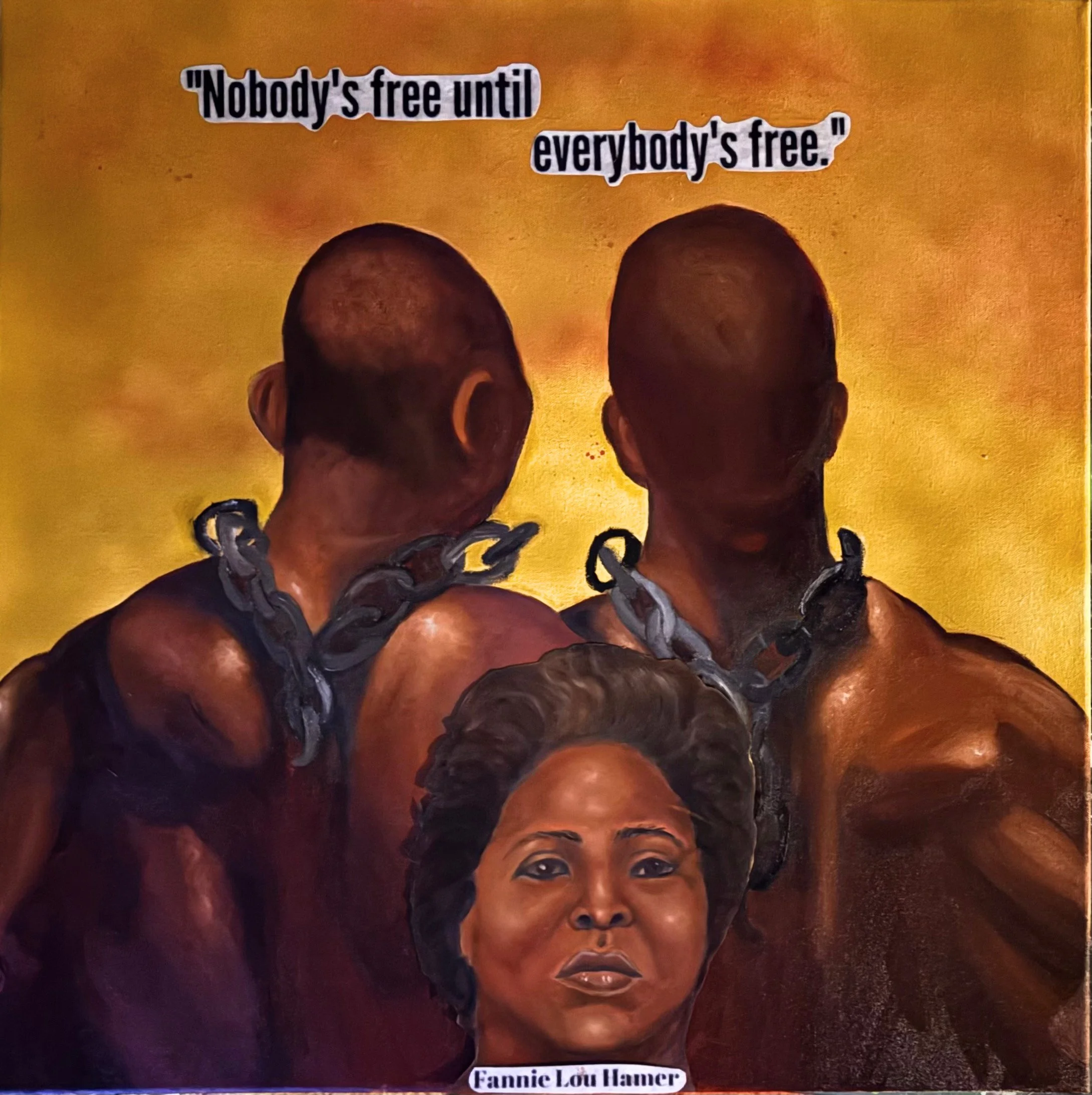
Her words, “Nobody’s free until everybody’s free,” are central to the painting. The quote is attributed to Hamer's July 10, 1971 speech at the founding meeting of the National Women’s Political Caucus. I wanted to visually connect her message of collective freedom to the history of enslavement. The two chained figures behind her represent generations who were denied physical freedom, while Hamer's portrait in the foreground represents the continuation of that struggle through activism, voting rights, and speaking truth to power.
I want viewers to first confront the weight of the chains and then meet Fannie Lou Hamer's unwavering gaze. The figures turn away from us, but Hamer faces us directly. That contrast is intentional: history may be behind us, but its consequences and the responsibility to understand it remain in front of us.
The golden background represents both value and possibility. Against the darkness of the chained figures, it suggests that freedom is precious, but it should never belong only to a select group.
Most importantly, I want viewers to consider Hamer's words for themselves: What does freedom really mean if someone else is still denied it? The painting is meant to connect past and present and encourage reflection on freedom not simply as an individual achievement, but as a responsibility we share with one another.
24×24 oil on paper/canvas. This work was inspired by Fannie Lou Hamer and her commitment to civil and voting rights. Hamer transformed her own experiences with racism, poverty, violence, and voter suppression into grassroots activism and became an important voice in the Civil Rights Movement.
Her words, “Nobody’s free until everybody’s free,” are central to the painting. The quote is attributed to Hamer's July 10, 1971 speech at the founding meeting of the National Women’s Political Caucus. I wanted to visually connect her message of collective freedom to the history of enslavement. The two chained figures behind her represent generations who were denied physical freedom, while Hamer's portrait in the foreground represents the continuation of that struggle through activism, voting rights, and speaking truth to power.
I want viewers to first confront the weight of the chains and then meet Fannie Lou Hamer's unwavering gaze. The figures turn away from us, but Hamer faces us directly. That contrast is intentional: history may be behind us, but its consequences and the responsibility to understand it remain in front of us.
The golden background represents both value and possibility. Against the darkness of the chained figures, it suggests that freedom is precious, but it should never belong only to a select group.
Most importantly, I want viewers to consider Hamer's words for themselves: What does freedom really mean if someone else is still denied it? The painting is meant to connect past and present and encourage reflection on freedom not simply as an individual achievement, but as a responsibility we share with one another.